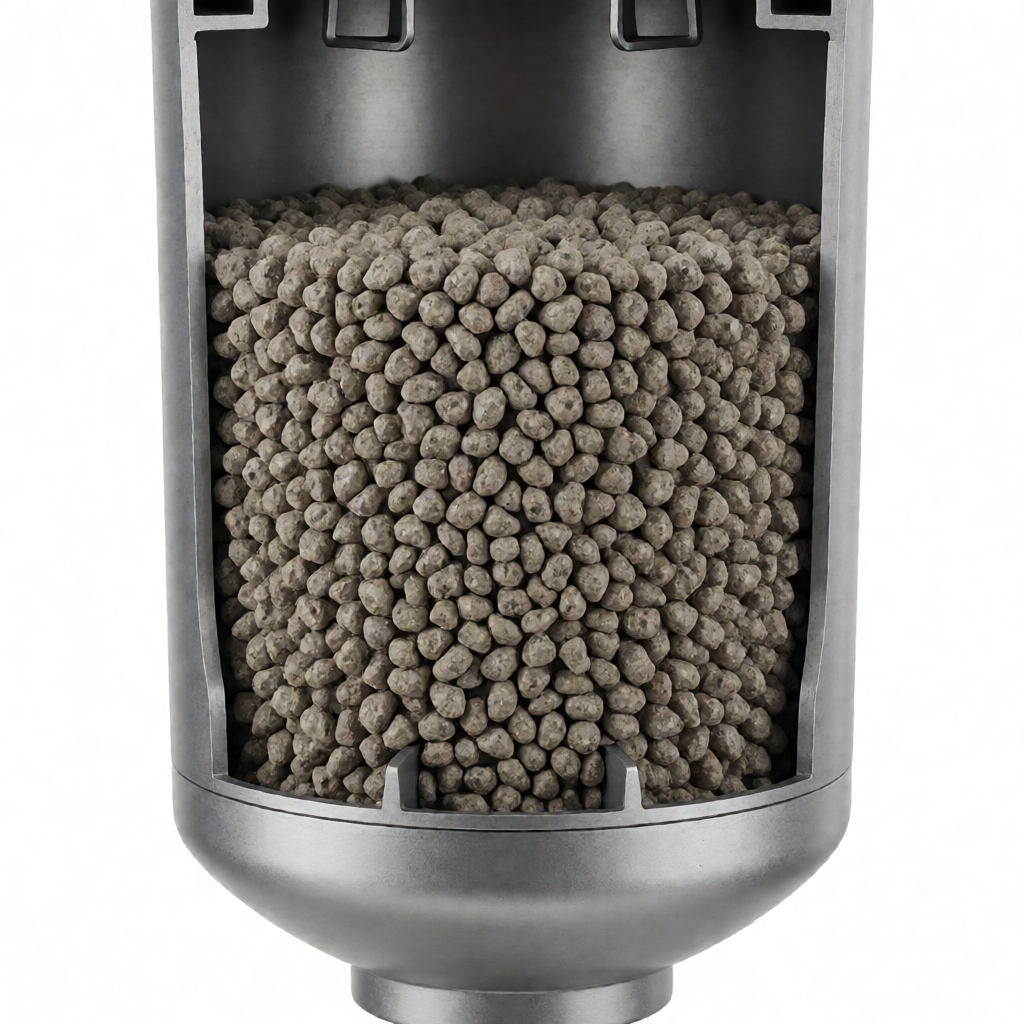
Quick Overview — Product Specifications at a Glance
A KDF shower filter is an inline whole-shower filtration unit that uses KDF-55 media — a copper-zinc alloy — to chemically reduce chlorine, chloramine, heavy metals, and limescale through redox reactions. For B2B buyers, the key question is not just whether the filter removes contaminants, but whether the media weight, flow rate, and cartridge lifespan align with your downstream project or retail margin targets.
Below is a snapshot of typical specifications found across credible manufacturers. These ranges represent current industry standards for commercial-grade shower water filters using KDF-55 media.
| Specification | Typical Range | What It Means for Buyers |
|---|---|---|
| Filtration capacity | 15,000 – 40,000 gallons | Total volume the cartridge can treat before media exhaustion |
| Flow rate | 1.5 – 2.5 GPM (US) / 5.7 – 9.5 L/min (EU) | Must match local plumbing codes and user comfort expectations |
| Cartridge life | 6 – 12 months (average household) | Depends on water quality, usage volume, and media weight |
| Media weight per cartridge | 80g – 250g KDF-55 | Higher media weight = longer life and broader contaminant removal |
| Connection type | ½” NPT standard | Universal fit for most residential and commercial shower lines |
| Housing material | ABS plastic or stainless steel | ABS is cost-effective; stainless offers premium durability for spa/hotel use |
These figures are reference points. Your actual specification will depend on water test results, municipal vs. well supply, and end-user expectations.
What Are the Key Specifications of KDF Shower Filters?
When evaluating a KDF shower filter supplier, you need to look beyond the headline media claim and examine the full specification envelope. Here are the parameters that matter most for bulk procurement.
Filtration capacity and media weight are directly linked. A cartridge containing 200g of KDF-55 will outperform a 100g unit in both service life and contaminant reduction range. Media weight also influences the pressure drop across the filter — heavier beds create more resistance, which can reduce flow rate if the housing design does not account for it.
Flow rate compliance is non-negotiable. In the US, most jurisdictions require a minimum of 1.5 GPM for shower fixtures. In Europe, EN 1179 standards govern flow performance. A supplier that cannot provide tested flow-rate data under standardized conditions is likely relying on marketing estimates rather than engineering validation.
Cartridge life should be stated in gallons or months, with clear test conditions. Reputable manufacturers publish replacement intervals based on average US municipal water quality (4 mg/L chlorine). If your target market has higher chlorine levels or uses chloramine (common in Western US cities), cartridge life may drop by 30–50%.
Housing durability affects warranty claims and replacement frequency. ABS plastic housings are standard for mid-tier products; they resist corrosion but can degrade under UV exposure if installed in outdoor spa settings. Stainless steel housings command a higher unit cost but deliver longer service life in high-turnover environments like hotels and spa bulk supply projects.
Certification alignment is part of specification. Look for NSF/ANSI 177 (shower filter standard) testing references, even if the product is not formally certified. Suppliers who publish third-party test reports demonstrate transparency. Those who only claim “NSF compliant” without documentation should be treated with caution.
Where Can KDF Shower Filters Be Used?
KDF shower filters are deployed across several B2B segments, each with distinct procurement drivers.
Hotel and spa operators require filters that reduce chlorine-induced dryness and irritation for guests, while also protecting plumbing and heating systems from scale buildup. These buyers typically specify filtered showerheads or handheld units with stainless housings and higher media weights for extended service intervals. Turnkey installation and tool-free cartridge replacement are critical for housekeeping efficiency.
Distributors and resellers evaluate filters based on margin potential, packaging consistency, and private-label readiness. They need suppliers who can provide OEM/ODM customization, consistent lead times, and documentation that supports their own marketing claims. A reliable shower filter supplier will offer tiered pricing based on order volume and support brand integration on housing and packaging.
Private-label buyers — including e-commerce brands and regional retailers — seek manufacturers who can produce under their own branding while maintaining performance parity with established names. This segment values specification transparency, modular design options, and the ability to bundle accessories (e.g., shower filter bundles with extra cartridges) without complex retooling.
Multi-unit residential projects (apartments, dormitories, senior living facilities) prioritize durability and low maintenance. These buyers often specify inline shower filters with standardized ½” NPT connections and cartridges that can be replaced without shutting down water service to adjacent units.
For deeper insight into sourcing channels, see our shower filter manufacturer and B2B sourcing guide and our filtered shower head manufacturer bulk guide.
What to Consider When Buying KDF Shower Filters in Bulk?
Procuring KDF shower filters at volume requires a structured evaluation framework. Here are the decision factors that separate experienced buyers from those who encounter hidden costs or performance shortfalls.
1. Verify media performance claims with third-party data.
KDF-55 is effective against chlorine and chloramine, but it does not soften water, remove bacteria, or eliminate fluoride. Any supplier claiming otherwise is making unsupported assertions. Request laboratory test reports showing reduction percentages for specific contaminants under standardized flow conditions.
2. Assess certification integrity.
ISO 9001 and IATF 16949 indicate quality management maturity, but they do not certify product performance. Look for suppliers who link every certification claim to a public database or testing laboratory report. This is the difference between verifiable evidence and marketing language.
3. Evaluate customization and private-label readiness.
If you plan to private-label, confirm that the supplier can accommodate your branding requirements — housing color, logo placement, packaging design, and cartridge labeling. MOQ flexibility matters here; some manufacturers require 5,000+ units for custom branding, while others accept lower volumes for standard white-label products.
4. Confirm installation and maintenance practicality.
Buyers consistently report frustration with sealed, non-replaceable cartridges. Ensure the product uses a replaceable filter cartridge system that can be swapped without specialized tools. Verify that replacement cartridges are available separately and priced competitively — this affects long-term customer satisfaction and repeat orders.
5. Understand lead time and logistics.
Bulk orders for distributor programs or hotel projects require predictable fulfillment. Ask suppliers about standard lead times for stock items versus custom orders, packaging configurations (master cartons, pallet sizes), and shipping options (FOB China, CIF, DDP). Incoterms clarity prevents unexpected cost overruns.
6. Request samples before committing to volume.
Never place a large order without testing at least one sample unit under real water conditions. Check flow rate, pressure drop, cartridge ease-of-replacement, and housing fit. This step catches specification mismatches before they become costly replacements.
Evidence & Practical Notes
Field note: Many buyers discover after bulk delivery that the stated flow rate was measured at 20 PSI, while their local municipal pressure operates at 40–60 PSI. Always confirm the test conditions behind published flow-rate claims.
Practical limitation: KDF media loses effectiveness as it becomes coated with oxidation byproducts. In areas with high iron or manganese levels, pre-filtration may be necessary to extend cartridge life. A supplier that does not disclose this limitation is not providing complete technical guidance.
Buyer takeaway: Prioritize suppliers who publish what their media does not remove. Transparency about limitations builds trust and reduces post-sale disputes. If a filter cannot soften water, say so upfront — that honesty separates credible manufacturers from opportunistic brands.
How Much Do Bulk KDF Shower Filters Cost? (FOB China)
Pricing for KDF shower filters at wholesale varies based on media weight, housing material, certification status, and order volume. The table below provides indicative FOB China pricing for trade buyers. These are bulk-order reference figures, not retail prices or binding offers.
| Product Type | Media Weight | Housing Material | MOQ Tier | Unit Price (USD) |
|---|---|---|---|---|
| Inline shower filter (basic) | 100g KDF-55 | ABS plastic | 500–999 units | $3.50 – $5.00 |
| Inline shower filter (standard) | 150g KDF-55 | ABS plastic | 500–999 units | $4.50 – $6.50 |
| Filtered showerhead (premium) | 200g KDF-55 | Stainless steel | 300–599 units | $12.00 – $18.00 |
| Handheld shower filter | 120g KDF-55 | ABS plastic | 500–999 units | $4.00 – $6.00 |
| Replacement cartridge (100g) | 100g KDF-55 | — | 1,000+ units | $1.20 – $1.80 |
| Replacement cartridge (150g) | 150g KDF-55 | — | 1,000+ units | $1.60 – $2.40 |
Indicative FOB China wholesale pricing for trade buyers — not a retail price and not a binding offer; final pricing depends on quantity, specification and order schedule.
Cost drivers explained:
- Media weight is the primary variable. Each additional 50g of KDF-55 adds approximately $0.80–$1.20 to unit cost, depending on alloy purity and granule size.
- Housing material accounts for 30–40% of total cost in premium units. Stainless steel housings require additional machining and surface finishing compared to injection-molded ABS.
- Certification testing incurs upfront laboratory fees that are amortized across order volume. Suppliers who absorb these costs into unit pricing typically price at a premium.
- Private-label customization (logo molding, custom packaging) adds $0.30–$0.80 per unit and may require minimum order thresholds.
For detailed pricing breakdowns and customization options, see our KDF shower filter manufacturing and procurement guide.
Request a bulk FOB quotation with your specification and volume.
How We Meet These Standards — Manufacturer Perspective
When evaluating a KDF shower filter supplier, the most reliable indicator of capability is not what a company claims, but what it publishes and verifies. At ZOOSHEN, we operate on a simple principle: every performance claim is backed by testable evidence, and every limitation is disclosed upfront.
Our ISO 9001 certification (since 2010) and IATF 16949 compliance reflect structured quality management processes — not just marketing badges. Each certification links to a public registry where buyers can independently verify status. We do not invoke FDA approval because shower filters are not medical devices; we state what the product actually does and does not do.
From a manufacturing standpoint, our 50,000 sq ft facility in China houses in-house CNC machining and surface finishing capabilities. This allows us to control housing precision, material consistency, and assembly tolerances without relying on third-party vendors for critical steps. For private-label buyers, this vertical integration means faster iteration on design changes and more predictable lead times.
We offer wholesale, OEM, and ODM programs for distributors, retailers, hotel and spa operators, and household purchasers on municipal or well water. Our product lines include inline shower filters, filtered showerheads, handheld units, replacement cartridges, and accessory bundles. Every cartridge is replaceable; no sealed throwaway designs.
What we do not do is overpromise. KDF-55 media reduces chlorine and chloramine through redox reaction, but it does not soften hard water, remove dissolved solids, or eliminate microbial contaminants. If your project requires those functions, we will tell you directly — and recommend a complementary filtration stage rather than selling an incomplete solution.
For additional context on supplier evaluation and procurement workflows, refer to our shower filter supplier sourcing guide for B2B buyers and our multi-stage shower filter manufacturing guide.
Sources & References
- shower filter manufacturer and B2B sourcing guide — zooshen.com
- filtered shower head manufacturer bulk guide — zooshen.com
- KDF shower filter manufacturing and procurement guide — zooshen.com
- Request a bulk FOB quotation with your specification and volume. — zooshen.com
- shower filter supplier sourcing guide for B2B buyers — zooshen.com
- multi-stage shower filter manufacturing guide — zooshen.com