Quick Overview
Shower water filters are inline or integrated filtration units designed primarily to reduce chlorine and chloramine from municipal supply before water reaches the skin and hair. For B2B buyers — distributors, private-label brands, hotel and spa operators, and retailer networks — the decision hinges on three things: what the media actually removes, whether the manufacturer can document it, and what the landed cost looks like at volume.
This page covers the specifications that matter for procurement, the certifications you should verify, typical bulk pricing ranges, minimum order quantities, lead-time norms, and how to evaluate a manufacturer before placing a private-label or wholesale order.
What are the key specifications of shower water filters?
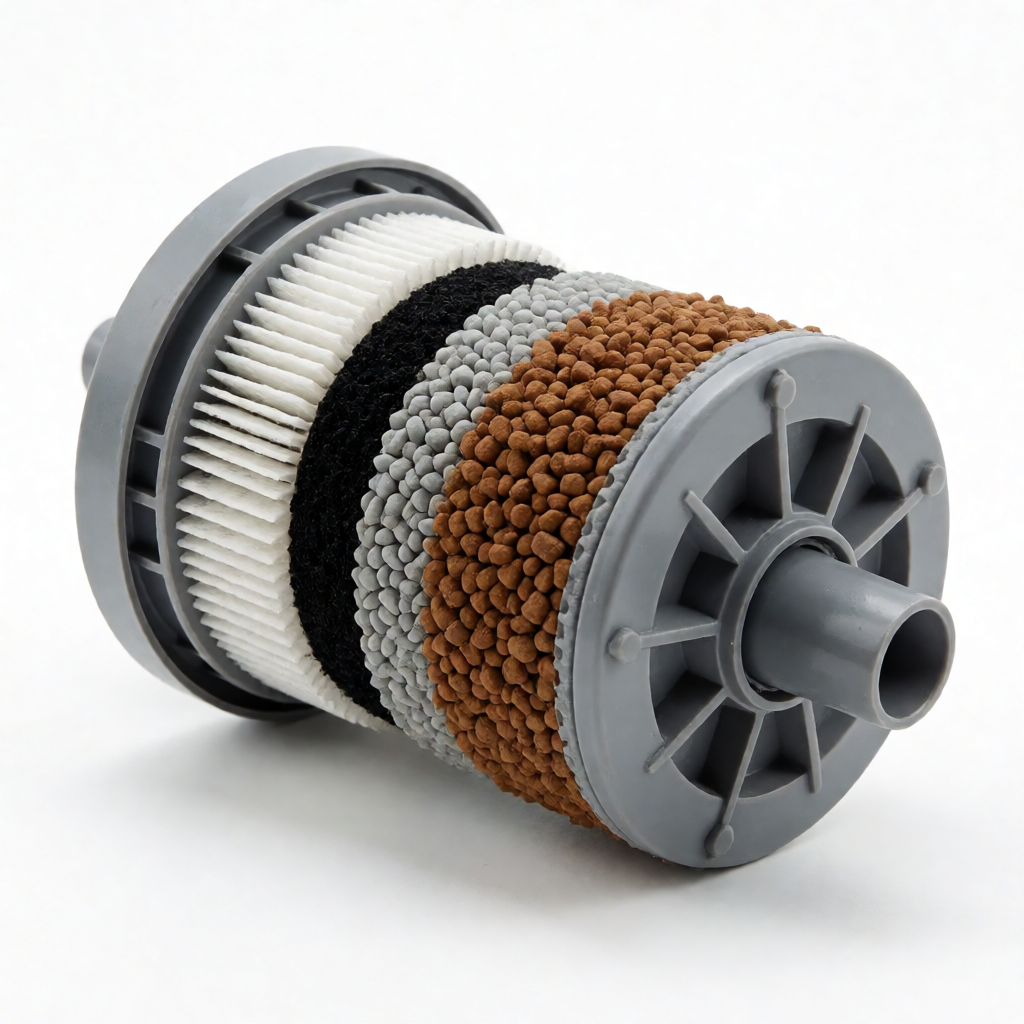
The specifications that drive a procurement decision fall into four categories: filtration media, flow rate, physical connections, and durability.
Filtration media is the core differentiator. The two most common media types in the B2B channel are:
- KDF 55 (Kinetic Degradation Fluxion): A copper-zinc alloy that reduces chlorine through a redox reaction. It is effective against chlorine and chloramine at municipal levels, resistant to bacterial growth, and retains performance over many months of use.
- Vitamin C (ascorbic acid) media: Neutralizes chlorine chemically. It does not remove chloramine effectively and requires more frequent replacement in chloraminated systems.
Some manufacturers offer multi-stage cartridges that combine KDF with calcium sulfite, coconut-shell carbon, or mineral stones. Each addition changes the contaminant profile, flow rate, and replacement interval.
Flow rate directly affects user experience and hotel/spa guest satisfaction. Most shower filters are rated between 2.5 and 4.0 gallons per minute (GPM). A filter that restricts flow below 2.0 GPM will feel weak, especially when multiple fixtures are running simultaneously. Flow rate is determined by media bed depth, particle size, and housing internal geometry — not simply by the inlet size.
Physical connections are typically ½-inch NPT (national pipe thread) for inline filters. Filtered showerheads integrate the media cartridge directly into the head, eliminating the need for a separate inline unit. Handheld shower filters use the same connection standard. When evaluating a supplier, confirm the thread specification and whether adapters are included — this is where many procurement errors occur.
Durability and service life depend on water quality and usage volume. A typical residential replacement cycle is 6–12 months, but in hard-water or high-chlorine municipal systems, the interval shortens. Hotel and spa installations with high turnover may need replacement every 3–6 months. The housing material (stainless steel, ABS plastic, or chrome-plated brass) also determines long-term corrosion resistance.
| Specification | Typical Range | Notes |
|---|---|---|
| Filtration media | KDF 55, Vitamin C, multi-stage blends | Media type determines contaminant target |
| Flow rate | 2.5 – 4.0 GPM | Below 2.5 GPM may feel weak to users |
| Inlet connection | ½-inch NPT (standard) | Confirm thread spec and adapter inclusion |
| Housing material | Stainless steel, ABS, chrome-plated brass | Impacts corrosion resistance and warranty |
| Cartridge service life | 6 – 12 months (residential) | Shorter under high chlorine or hard water |
| Weight | 150 – 400 g (inline); 500 – 900 g (filtered showerhead) | Affects packaging and freight cost |
Where can shower water filters be used?
Shower water filters serve distinct commercial and residential procurement channels, each with its own specification priorities.
Hotel and spa procurement prioritizes guest experience and replacement cost per unit. High-turnover properties benefit from filters with longer service intervals and tool-free cartridge replacement. The filtration target is usually chlorine reduction for skin and hair comfort, not potable-water certification. Suppliers should offer consistent lead times, bulk pricing tiers, and spare-cartridge availability.
Distributor and retailer sourcing focuses on margin structure, private-label compatibility, and certification documentation. Distributors need products with verifiable performance data, resale-ready packaging, and warranty terms that protect their end customers. Retailers often source both branded and private-label SKUs.
Private-label branding projects require an OEM or ODM partner who can accommodate custom housing colors, logo placement, packaging design, and media configuration. The manufacturer must have the CNC machining and surface-finishing capability to produce consistent results at volume.
Multi-unit residential supplies (apartment complexes, student housing, co-living spaces) share similarities with hotel procurement: high usage, cost-sensitive replacement cycles, and the need for durable, easy-to-maintain units.
For a detailed sourcing framework, see the shower filter manufacturer B2B sourcing guide and the filtered shower head manufacturing and bulk procurement guide.
What to consider when buying shower water filters in bulk?
Several factors determine whether a bulk order will perform as expected or become a cost center. Evaluate each before signing a purchase agreement.
Media performance and contaminant targets. Confirm which contaminants the selected media removes and which it does not. KDF 55 reduces chlorine and chloramine; vitamin C neutralizes chlorine but is ineffective against chloramine. If your market has chloraminated water, specifying vitamin C-only media will result in product complaints. Request third-party test data or certification reports for the specific media combination.
Certification and quality-standard documentation. A reputable manufacturer should hold ISO 9001 certification for quality management systems. For products marketed in North America, verify whether the filter meets NSF/ANSI 177 (the standard for shower filters), which covers microbiological and contaminant reduction performance. Certification documents should be publicly verifiable — look for certification numbers that can be cross-checked on the issuing body’s database. NSF International maintains public certification records.
MOQ, lead time, and order flexibility. Minimum order quantities vary by manufacturer and product type. Inline filters typically have lower MOQs than filtered showerheads because of simpler tooling. Lead times range from 15 to 45 days depending on order volume, customization level, and factory schedule. Clarify whether the quoted lead time includes mold creation (for custom colors or logos) or only production.
Customization and OEM/ODM capabilities. If you are building a private-label brand, the manufacturer must support custom housing finishes, packaging, and media configurations. In-house CNC machining and surface finishing are strong indicators that a factory can handle customization without outsourcing — which protects quality and timeline. Review the handheld shower filter manufacturing guide and the shower filter cartridge manufacturers guide for additional sourcing context.
Durability and replaceability. Filters with sealed, non-replaceable cartridges are a cost trap for B2B buyers. Tool-free install and replaceable cartridges reduce lifetime cost and enable a recurring revenue stream through cartridge refills. Ask whether the cartridge is a consumable SKU you can source separately after the initial order.
Regional water-quality variation. Municipal water quality varies significantly by city and even by neighborhood. A filter that performs well in one market may underperform in another due to differences in chlorine dose, chloramine presence, hardness, or pH. If you are distributing in multiple regions, consider specifying media configurations based on local water reports rather than a single blanket specification.
How much do bulk shower water filters cost? (FOB China)
Bulk pricing for shower water filters depends on product type, media configuration, housing material, order volume, and customization requirements. The ranges below are indicative FOB China wholesale prices for trade buyers — they are not retail prices and not binding offers. Final pricing depends on quantity, specification, and order schedule.
| Product Type | Typical Spec | Price Range (USD/unit) | MOQ Tier |
|---|---|---|---|
| Inline shower filter (basic KDF) | ½” NPT, stainless housing, standard media | $8 – $15 | 100+ sets |
| Inline shower filter (multi-stage) | ½” NPT, advanced media blend | $15 – $28 | 100+ sets |
| Filtered showerhead | Chrome/ABS, integrated cartridge | $25 – $60 | 50+ units |
| Handheld shower filter | With hose, integrated unit | $18 – $40 | 50+ units |
| Replacement cartridge | KDF or vitamin C, standard size | $2 – $5 | 500+ pcs |
| Shower filter bundle (filter + cartridge) | Retail-ready packaging | $12 – $22 | 100+ sets |
Indicative FOB China bulk-order pricing for trade buyers — not a retail price and not a binding offer; final pricing depends on quantity, specification and order schedule.
Several variables shift the price outside these ranges:
- Custom housing color or finish adds tooling or surface-finishing costs, particularly for chrome or matte black options.
- Logo printing or laser engraving requires setup fees on the first order but marginal cost per unit is low.
- Private-label packaging (polybag, retail box, or blister pack) adds $0.50 – $3.00 per unit depending on complexity.
- Certification requirements (NSF/ANSI 177 testing, WQA listing) increase per-unit cost through testing fees and quality-control overhead.
- Order frequency matters: recurring monthly orders often qualify for better pricing than one-off purchases.
For a deeper breakdown of pricing variables, see the shower head filter manufacturing and bulk procurement guide.
Request a bulk FOB quotation for your specific configuration and volume.
Evidence & Practical Notes
Field note: KDF media performance drops noticeably in cold-water showers below 10°C (50°F). The redox reaction slows at lower temperatures, so a filter specified for warm-climate markets may underperform in colder regions unless the media bed is oversized to compensate. This is a real-world factor that rarely appears in spec sheets.
Practical limitation: Multi-stage cartridges that add carbon, mineral stones, or additional media layers increase filtration depth but also increase flow restriction. A filter rated at 4.0 GPM with basic KDF may drop to 2.5 GPM with a five-stage blend. For hotel and spa applications where guest satisfaction is driven by shower experience, the flow trade-off can undermine the value of additional filtration stages.
Buyer takeaway: Prioritize verified media performance for your target contaminant (chlorine vs. chloramine) and acceptable flow rate over the number of filtration stages. A well-specified two-stage KDF filter that delivers 3.5 GPM will outperform a five-stage filter that restricts to 2.0 GPM in most commercial settings. Cross-check any certification claim against the issuing body’s public database before placing an order.
Manufacturer Profile and Capability Snapshot
When evaluating a shower water filter manufacturer, the questions that matter are: can they deliver consistent quality at scale, do they document what their media removes, and can they support your private-label or distribution requirements?
ZOOSHEN Technology Co., Ltd. operates as a manufacturer of shower water filtration systems — inline filters, filtered showerheads, handheld units, and replacement cartridges — with a focus on chlorine and chloramine reduction. The company was established in 2008 and operates from a 50,000 sq ft facility equipped with in-house CNC machining and surface-finishing capabilities. This means customization — from housing color to logo application — does not require outsourcing to a third party, which protects lead times and quality consistency.
The company holds ISO 9001 certification (since 2010) and IATF 16949 certification, reflecting adherence to quality-management standards that are relevant for B2B manufacturing. Every filtration media claim is backed by verifiable test data, and certification documents can be cross-referenced in public databases — the approach is evidence over assertion.
From a procurement standpoint, the manufacturer supports wholesale, private-label/OEM programs, and direct supply to hotel and spa operators. Cartridges are designed for tool-free installation and replacement, which reduces lifetime cost for end users and creates a recurring revenue opportunity for distributors. The product portfolio covers the full range of shower filtration formats — inline, filtered showerhead, handheld, and replacement cartridges — allowing buyers to source multiple SKUs from a single manufacturer.
For buyers evaluating manufacturing capability, the combination of in-house machining, documented quality certifications, and a media-performance disclosure policy addresses the three most common sourcing risks: inconsistent quality, unverifiable claims, and inability to customize.
For more detail on sourcing strategies and supplier evaluation, see the shower filter supplier sourcing and procurement guide.
Contact our team to discuss your procurement requirements, review spec sheets, or request a sample.
Sources & References
- shower filter manufacturer B2B sourcing guide — zooshen.com
- filtered shower head manufacturing and bulk procurement guide — zooshen.com
- NSF International — www.nsf.org
- handheld shower filter manufacturing guide — zooshen.com
- shower filter cartridge manufacturers guide — zooshen.com
- shower head filter manufacturing and bulk procurement guide — zooshen.com
- Request a bulk FOB quotation — zooshen.com
- shower filter supplier sourcing and procurement guide — zooshen.com