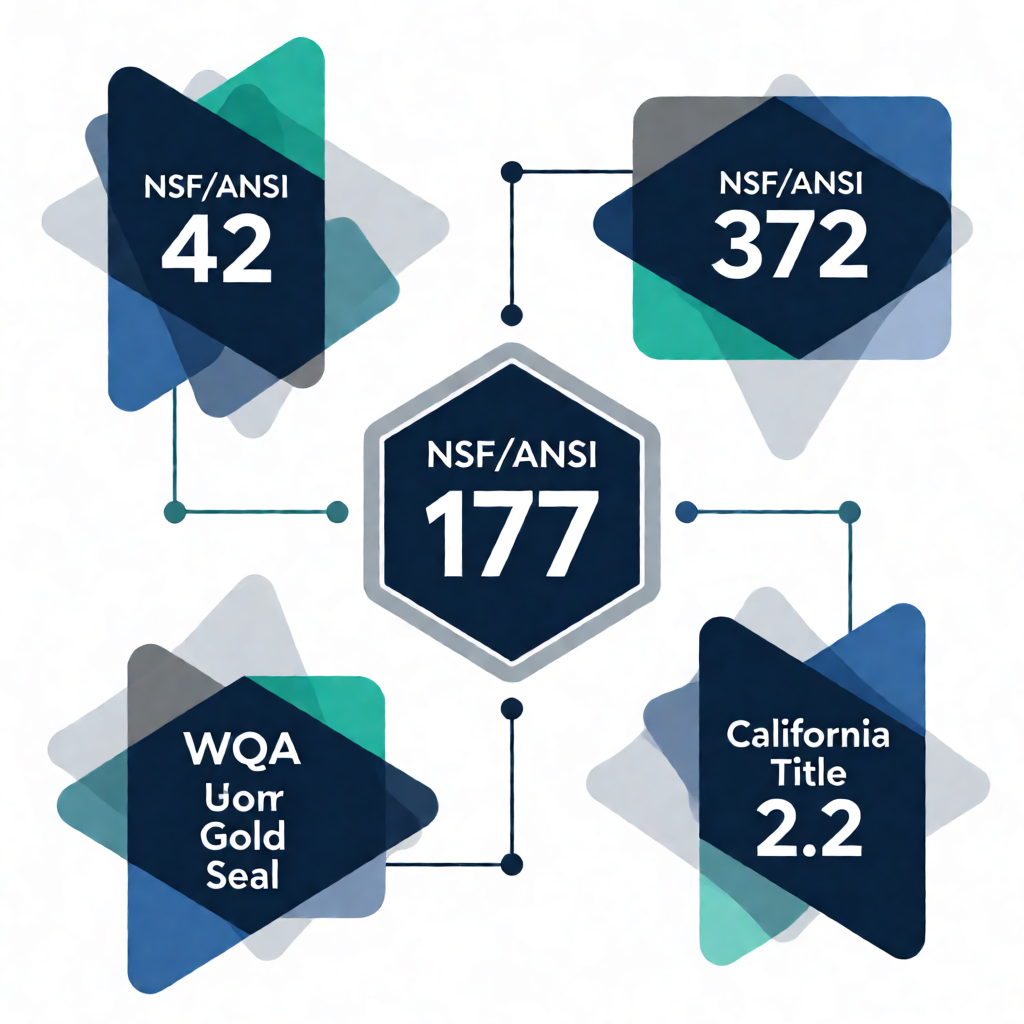
Quick Answer: What Is NSF/ANSI 177 Certification?
NSF/ANSI 177 is a plumbing product material safety standard developed jointly by NSF International and the American National Standards Institute. It defines the test methods and requirements used to ensure that materials inside plumbing components — including shower water filter housings, seals, cartridge media mounts, and internal flow paths — do not leach harmful contaminants such as lead, bisphenol-A (BPA), and bisphenol-B (PBA) into water.
In practical terms, the certification answers a single buyer question: what you are filtering with is not adding something worse to the water. NSF/ANSI 177 does not evaluate how well a filter removes chlorine or chloramine. It evaluates whether the product itself stays clean under real water-contact conditions.
The standard is voluntary in most US jurisdictions but has become a baseline specification in wholesale procurement, hotel and spa plumbing compliance programs, and private-label product development where distributors require documented material safety.
Detailed Explanation: How Does NSF/ANSI 177 Work?
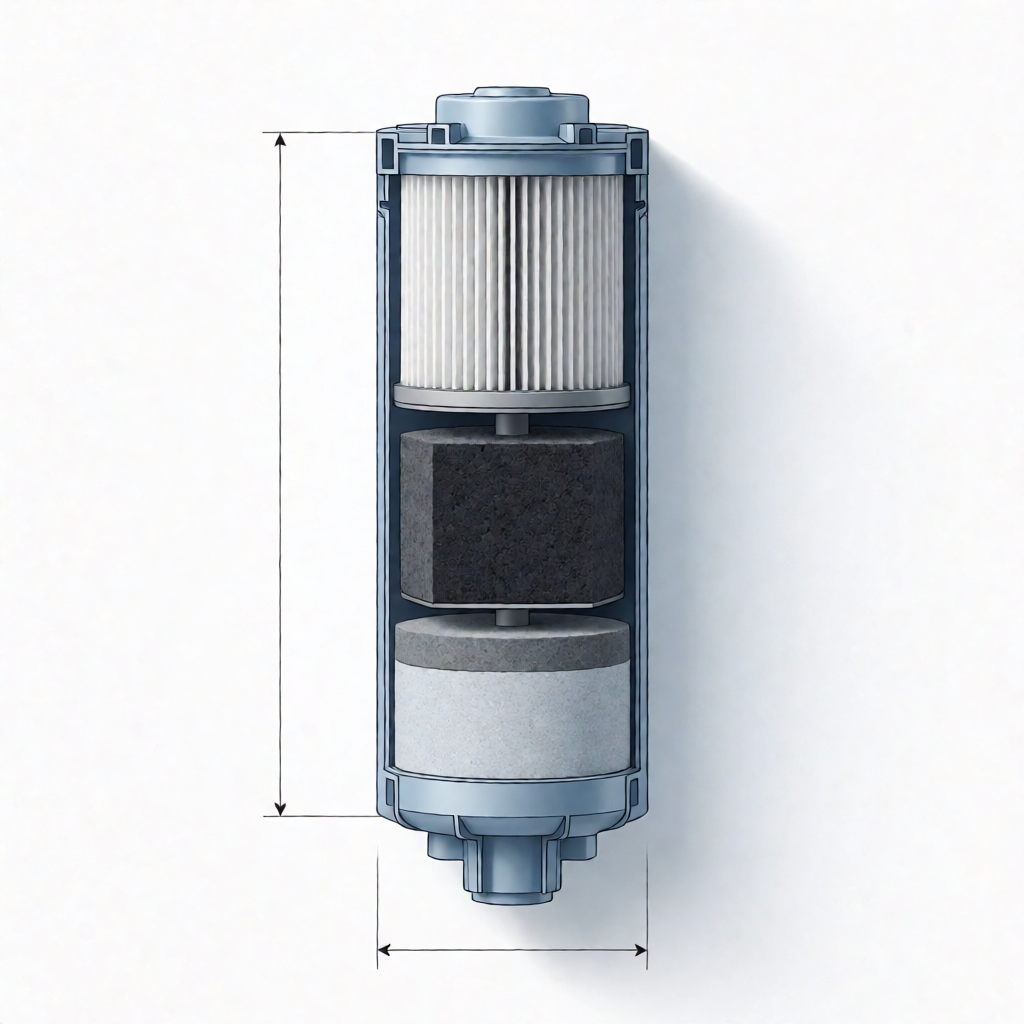
What NSF/ANSI 177 actually tests — and what it does not test
NSF/ANSI 177 is a material extractables standard. It measures what comes out of the product when water sits in or flows through it under controlled conditions. The test involves:
- Exposing filter housing materials, gaskets, cartridges, and internal wetted components to demineralized water
- Running the exposure for a defined number of volumes and hours
- Analyzing the collected water for specific contaminants using approved laboratory methods
The contaminants measured are focused on substances known to migrate from plastics, rubber compounds, and metal alloys used in plumbing parts. If leaching exceeds the standard’s thresholds, the product fails certification.
What the standard does not test:
- Contaminant removal performance — chlorine, chloramine,铅, cysteis, or sediment reduction falls under different standards such as NSF/ANSI 42 (aesthetic effects) or NSF/ANSI 401 (emerging compounds). A product can hold NSF/ANSI 177 certification without removing any specific health-related contaminant.
- Flow rate or pressure drop — hydraulic performance is outside the scope.
- Microbial safety — no antibacterial or sanitization claims are covered.
How buyers should interpret the certification on a spec sheet
When you see “NSF/ANSI 177 certified” on a shower filter datasheet, the correct reading is: the manufacturer verified that the wetted materials meet extractables limits for lead, BPA, and PBA. It is a hygiene-of-construction claim, not a performance claim.
Buyers should expect the certification to appear alongside a certificate number. That number should be publicly verifiable through the NSF database rather than resting on a logo alone. This is where many marketing-driven spec sheets fall short — the seal is displayed without the traceable registration record.
Key Specifications: What Are the Tested Parameters?
The extractables testing under NSF/ANSI 177 focuses on a defined contaminant panel. The key parameters include:
| Parameter | Why it matters in a shower filter |
|---|---|
| Lead (Pb) | Can leach from certain brass fittings, soldered joints, or plated internal components; chronic exposure is the primary public-health concern behind material safety standards |
| BPA (bisphenol-A) | Migrated from some polycarbonate plastics and epoxy linings; endocrine-disruption risk is the reason it is included in the panel |
| PBA (bisphenol-B) | Similar chemical family to BPA; appears in certain resin systems and polymer blends |
| Total organic carbon (TOC) | Indirect indicator of general plasticizer or resin migration; elevated levels suggest broader material instability |
| pH and conductivity shifts | Monitor whether the filter media or housing changes water chemistry simply by contact |
The exact threshold values are published in the standard itself. They differ depending on the material class and the volume-to-surface-area ratio of the component being tested. Shower filter housings and cartridge inserts are evaluated as small-volume plumbing components, which means the allowed extractables are tight relative to the amount of water that passes through them.
How the extraction procedure works in practice
NSF/ANSI 177 requires running a defined water volume through the product at a specified flow rate and temperature, then capturing and analyzing the effluent. The procedure mimics real use — prolonged contact, repeated cycles, and warm water conditions that accelerate leaching. Results are compared against the standard’s maximum contaminant levels.
Standards & Requirements: How Does NSF/ANSI 177 Relate to Other Standards?
NSF/ANSI 177 vs. NSF/ANSI 61
These two standards are frequently conflated because both deal with plumbing material safety, but they serve different purposes.
NSF/ANSI 61 is the broader drinking-water-systems standard. It covers extractables testing for a much wider range of components — pipes, valves, fittings, water softeners, and treatment units — and includes a larger contaminant panel than 177. If a product falls under NSF/ANSI 61, it has typically passed a more comprehensive material evaluation.
NSF/ANSI 177 is narrower. It targets consumer plumbing products such as faucet aerators, shower components, and small treatment devices. The scope is specific, and the contaminant panel is smaller. For a shower water filter, NSF/ANSI 177 is the more directly applicable standard, while NSF/ANSI 61 might apply if the same manufacturer also produces whole-house systems.
A useful shorthand: NSF/ANSI 61 is the general plumbing-material standard; NSF/ANSI 177 is the targeted consumer-product variant. Some manufacturers hold both certifications to cover different product lines.
NSF/ANSI 177 vs. NSF/ANSI 372
NSF/ANSI 372 addresses lead content limits in plumbing products rather than extractables. It sets a maximum weighted-average lead content of 0.25 percent for “lead-free” designation. A product can comply with NSF/ANSI 372 and still fail NSF/ANSI 177 if its plastics leach BPA or other organics. Conversely, a product can pass 177’s extractables limits while not meeting 372’s lead-content cap if brass components are used.
For shower filters, the two standards complement each other: 372 checks the metal alloy composition, while 177 checks what actually migrates into the water during use. Smart procurement specifies both.
How the standard connects to chloramine and chlorine filter media
This point is important for buyers evaluating shower filters that advertise chloramine removal.
NSF/ANSI 177 does not certify that a filter removes chlorine or chloramine. However, the standard is highly relevant to the construction materials inside a chloramine-removal filter. Chloramine is more oxidizing than free chlorine and can degrade certain elastomers and resin systems over time. A housing or gasket material that passes NSF/ANSI 177 under controlled extraction conditions gives buyers confidence that the media housing and seals remain stable even when exposed to aggressive oxidants.
In other words: the standard does not measure removal efficiency, but it does help validate that the filter’s internals won’t break down and contaminate the filtered water during the product’s intended service life. When evaluating a chloramine removal shower filter, verifying NSF/ANSI 177 compliance on the housing and cartridge materials is one way to confirm the manufacturer has thought through material compatibility, not just adsorption chemistry.
Related Considerations: What Should You Know Before Buying?
How to verify a genuine NSF/ANSI 177 certification
A certificate number is only meaningful if it can be traced. Here is the verification workflow buyers should follow:
- Request the certificate number from the manufacturer or supplier. A legitimate certification will always come with a registration or listing number.
- Check the NSF Public Certification Database. Enter the product name, model number, or certificate number at nsf.org to confirm the listing is active and matches the exact SKU being purchased.
- Confirm the scope. The database record should show the standard (NSF/ANSI 177) and the specific product family covered. Some certificates cover an entire line; others cover a single model.
- Watch for red flags. Vague claims such as “meets NSF 177 standards” without a certificate number, logos that look printed rather than official, or dates that do not appear in the NSF database are strong indicators of unverified assertions.
What the certification does not cover — and why that matters
Buyers sometimes assume NSF/ANSI 177 guarantees the filter will remove contaminants effectively. It does not. Understanding the boundary prevents costly specification errors.
| What NSF/ANSI 177 certifies | What it does not certify |
|---|---|
| Material extractables limits for lead, BPA, PBA, and select organics | Chlorine or chloramine removal performance |
| That wetted parts do not leach harmful substances under test conditions | Flow rate, pressure drop, or filter lifespan |
| Compliance of the housing, seals, and internal hardware | Carbon media quality, grain size, or adsorption capacity |
| That the product was manufactured under a quality management system (when paired with ISO 9001 surveillance) | Chemical compatibility with aggressive oxidants beyond the extraction test |
If a procurement spec requires both material safety and contaminant removal, the correct combination is typically NSF/ANSI 177 plus NSF/ANSI 42 (for aesthetic contaminant reduction) or NSF/ANSI 53 (for health-related contaminant reduction), depending on what the filter claims to remove.
Private-label and wholesale implications
For buyers developing private-label shower filters or sourcing for hotel and spa installations, NSF/ANSI 177 compliance is often the first gate in a vendor qualification process. Distributors and facility operators want documents they can hand to a building inspector or compliance officer without guessing.
A robust specification package should include:
- The NSF/ANSI 177 certificate number and scope
- The corresponding NSF/ANSI 42 or 53 certificate if removal claims exist
- Material declarations for the media, housing, and seals
- Batch-level quality records from the manufacturer
Without these documents, a product may look attractive on paper but will not clear procurement review for institutional buyers.
How Manufacturers Approach NSF/ANSI 177 Compliance
As a manufacturer, our approach to NSF/ANSI 177 compliance starts with material selection before tooling begins. We do not treat certification as a post-production test; we design the wetted components to meet the extractables limits from the start.
Every shower filter housing, cartridge mount, and internal seal is evaluated against the standard’s contaminant panel before we commit to production tooling. When a material change is made — whether for cost, supply-chain resilience, or performance — we revalidate the extractables because a different resin batch or a substitute elastomer can shift the leaching profile even if the part looks identical.
Our products are tested under conditions that simulate extended shower use: warm water, repeated flow cycles, and the full volume range buyers will see in real installations. The results determine whether a component moves into production or returns to the design bench.
We also make sure the certification scope matches the actual product line. A certificate that covers five models does not protect a sixth. For wholesale procurement specification and private-label product development, we provide the exact certificate numbers and the NSF database record so buyers can independently verify every SKU they intend to distribute.
When hotel and spa operators ask whether a filter is safe for chloramine-treated water, the answer has two parts: the removal media handles the chloramine chemistry, and the NSF/ANSI 177 compliance on the housing and seals ensures no new contaminants enter the water stream. Both pieces belong in the spec sheet.
Sources & References
- nsf.org — www.nsf.org
- Talk to Sales — zooshen.com